Hey Worm People,
It’s hot!
And it's only getting hotter. We have the luxury of sweating when it gets hot. Our Worms cannot regulate their own body temperature. When it gets hot, worms will search for cooler environments because their temperature is their environment's temperature. The heat makes them lethargic, and they will create fewer castings and cocoons.
Controlling the temperature in your bin is the best way to keep your herd safe during the summer. That is why we gathered this information to share with you.
Before we chill out, we encourage you to join our community forum. Worm people are the best, and you will find no larger gathering of worm people who are serious about worming than in our community forum. Join the forum, introduce yourself, and dig around for information. Once you settle in, contribute.
We would also like to encourage you to take our course, Learn to Worm. We poured years of experience and hundreds of hours of work into creating what we know is the most comprehensive, easy-to-follow course that can introduce you to worm farming. It will give you the tools you need to manage your worm farm successfully. Sign up today!
 Take the next step in your Worm journey today!
Let's dive into the cool pool and learn to beat the heat.
The optimal temperature range by breed of worm
The four main breeds have slightly different temperature tolerances. Blues and ANCs are more heat tolerant. The specific temperature ranges for each breed are as follows.
1. Red Wigglers:
- Ideal temperature range: 65-77°F (18-25°C)
- Tolerance limits: 39-90°F (4-32°C)
2. European Nightcrawlers (Eisenia hortensis or Dendrobaena veneta)
- Ideal temperature range: 59-77°F (15-25°C)
- Tolerance limits: 39-86°F (4-30°C)
3. Indian Blue Worms (Perionyx excavatus)
- Ideal temperature range: 68-86°F (20-30°C)
- Tolerance limits: 59-95°F (15-35°C)
4. African Nightcrawlers (Eudrilus eugeniae)
- Ideal temperature range: 75-86°F (24-30°C)
- Tolerance limits: 68-95°F (20-35°C)
Impact of Heat on Worm Health
High temperatures hurt our worms in multiple ways.
- Dehydration: Excess heat can dry out our bins quickly. Without adequate moisture levels in the bin, our worms will dehydrate and die.
- Lethargy: high temperatures reduce the overall activity in the worm bin. Your worms will not eat or breed when the environment is not ideal.
- Microbial impact: Worms eat microbes, and the types of microbes change when the temperature rises. This can impact your herd's overall health.
- Nutrient loss: Higher temperatures will increase the decay rate of the organic matter in the bin, leaving less food for your worms.
- Escape: When it's too hot, worms will cluster in the corners of your bin. They will try to climb the walls and escape. They are always searching for the optimal environment; if your bin is not optimal, they instinctively try to escape it.
- Death: The worst-case scenario. If your adults are trying to escape. Your juveniles and cocoons are cooking. They do not have the luxury of escape. Cocoons can survive wider temperature extremes, but the young ones will not.
Impact on Castings, Cocoons, and Juveniles
High temperatures can significantly impact worm castings, cocoons, and juvenile worms:
- Castings: Heat reduces worm activity, leading to fewer and lower-quality castings. Dehydrated castings lose beneficial microbial life, making them less effective as soil amendments.
- Cocoons: Worm cocoons are vulnerable to heat and can dry out, leading to the embryos' death. Prolonged heat exposure can delay hatching, reducing reproduction rates.
- Juveniles: Young worms are highly sensitive to temperature changes. High temperatures can cause rapid dehydration and increased mortality rates, slowing their growth and development.
What you measure, you manage
The first step in managing the temperature in your worm bin is monitoring it. Monitor your bin temperature with the Reotemp 16 Inch Compost Thermometer (Amazon Affiliate Link).
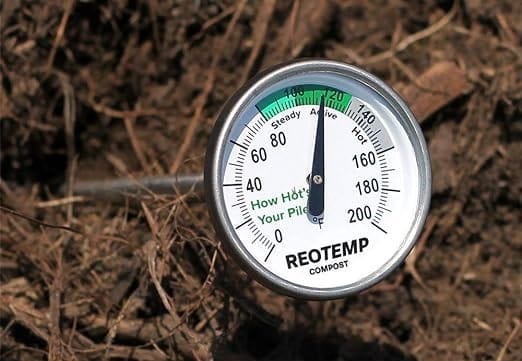 Buy the Reotemp Compost Thermometer on Amazon (Affiliate Link)
We receive a small commission if you purchase through our affiliate link at no additional cost. Thank you for your support. We recommend you check your local nursery or garden supply store first. Local is always better.
Controlling the Heat in your Worm Bin
Our worm bin's two main heat sources are the environment and organic matter decomposition. We can control for each of the variables. Here are six ways to control the temperature in your worm bin during these hot summer months.
Placement
Like real estate, worm farming is all about location, location, location. The best way to control the temperature of your worm bin is to place it in a location where it is safe.
- Indoors: Climate control is the best situation, but it is not always available.
- Underground: Basements work perfectly because of the ambient ground temperature and the higher humidity levels.
- Shade: If you must keep your bin outside, give it as much shade as possible. The shade will help with unnecessary solar energy.
- Inground: Buried bins work great in regulating temperature. Burying your bin in the ground is a great way to protect them from the heat - but can risk contamination by other worm breeds if not fully isolated.
If the ambient air temperatures are too high, the bin will heat up to unsafe levels even in the shade. You need to incorporate other methods listed below.
Ventilation
Keeping the air moving will help cool your bin. Water evaporates as the air moves through the soil and over the surface. Evaporation removes heat. The downside is that it will dry out your bin, and you must keep it in the optimal moisture range.
Moisture Control
Balancing the moisture levels will help regulate your worm bin’s temperature. Evaporation will cool the bin, but this effect will not outperform the ambient heat in the air in humid environments. Too much moisture promotes anaerobic activity, but too little will dry out your worms and reduce total microbial life. Water carries large quantities of heat energy. Striking the balance between moisture and temperature will stabilize the temperature of your bin.
Strategic Feeding
The food we add to our bin decomposes, and the microbes eating it create exothermic heat, like your uncle sweating over that steak his cardiologist told him not to eat. The process of decomposition heats the worm bin. Be careful; don't overfeed your worms during the summer.
Only feed in one place, allowing the worms plenty of space to escape the spike in temperature from the initial feeding.
Another great tip we gathered from the community is to freeze your produce. This will kill pest eggs, break down the cell walls of the vegetables, and cool your bin. Some worm people blend the food before freezing so it is readily available to the worms as it thaws.
The only caveat is that the food will create heat as it decays. The total heat, from the nitrogen load will not change because the food is frozen.
Reducing the total amount of nitrogen you feed your bin during the summer will help control the temperature. You can increase the amount of carbon. This will slow down the total castings produced, but you don't risk cooking your worms.
Insulated Top Layer
Covering your bin with a carbon layer like cardboard or leaf mulch protects it from temperature swings. If you feed in zones, you can strategically water the top layer above the food to allow heat to dissipate. Keeping the bedding above the feeding zone wet while the other areas dry will allow the heat to rise from the feeding zone and escape the bin while protecting the neutral areas of your bin from extreme temperature swings.
Hot Composting Before Feeding
- Pre-Composting Food Waste: Before adding food waste to your worm bin, consider pre-composting it through a hot composting process. This involves allowing the organic material to decompose in a separate pile or bin until it reaches a stable, cooler temperature.
- Benefits: Hot composting accelerates the breakdown of organic matter, reducing the heat generated inside the worm bin. By feeding your worms pre-composed material, you minimize the risk of overheating and provide a more stable environment for them.
- How to Hot Compost: Create a separate compost pile or bin, add food waste, and maintain high temperatures (130-160°F or 54-71°C) by regularly turning the pile and ensuring proper aeration. Once the compost has cooled down, it can be safely added to your worm bin.
Cooling Systems
Worm farming is a perfect example of “mad science.” We plot, plan, and scheme different contraptions or builds. We spend night after night researching microbiology, thermodynamics, and soil sciences. This is one area where you can apply all that DIY ingenuity. Here is a large list of interesting cooling devices and techniques.
- Frozen water bottles: This is the most common one. You’ve probably already implemented it. It's cheap, easy, and recyclable. If it works and you have the freezer space and time, keep at it. This is the simplest way to manually cool down your bin. It is also a way to reduce, reuse, and recycle plastic bottles.
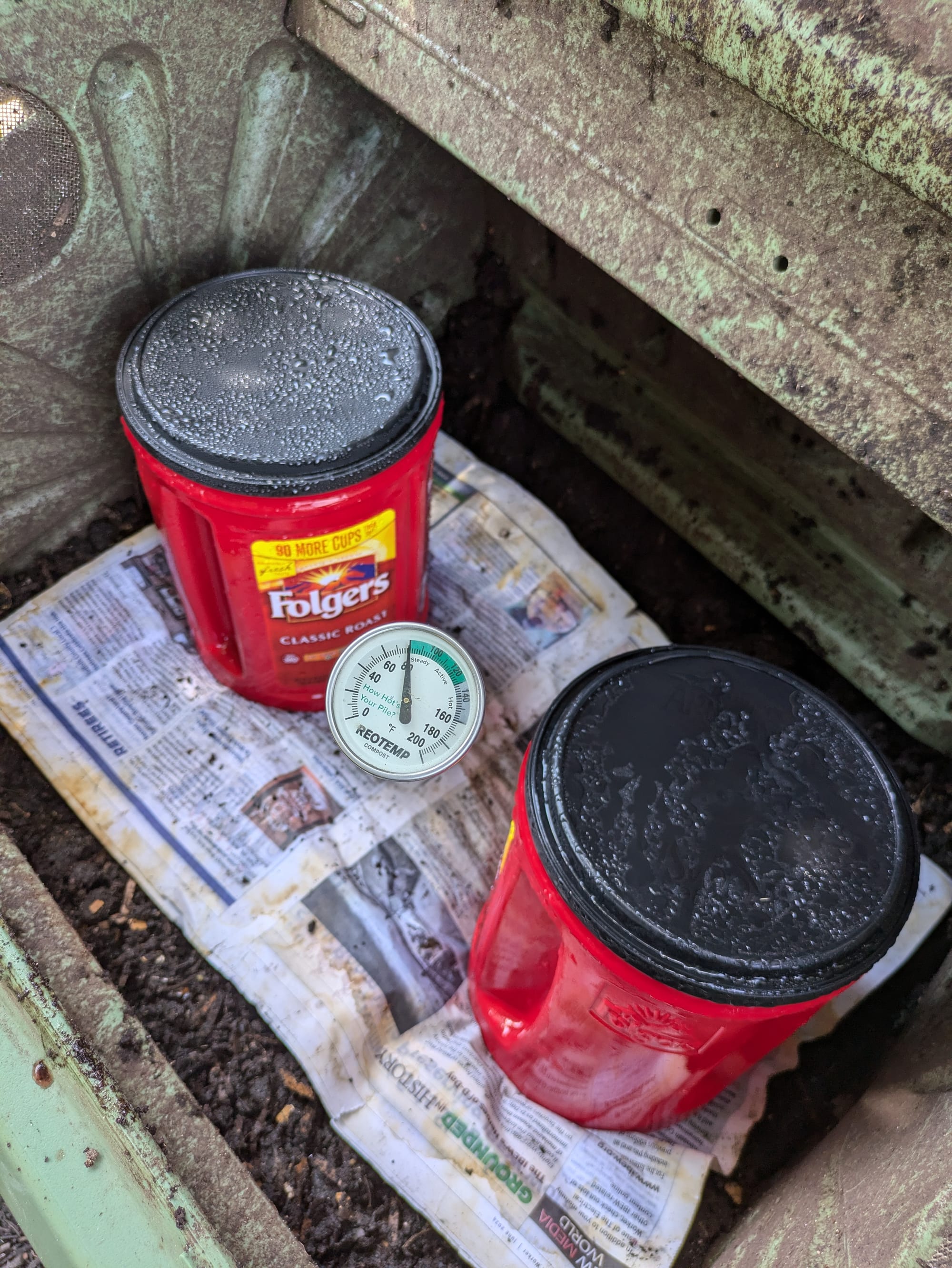 Here is Worm People Community Member Dennis Downing's Setup. He uses two Folger's coffee containers.
- Evaporative Coolers: One form of evaporative cooling is placing a wet towel over your bin and blowing a fan over it. In dry climates, this works great. If you live somewhere humid, these are not as efficient. They work by extracting heat from the air through the phase change of water. There are standalone evaporative coolers, but they will raise the humidity levels in the environment, and if it's already humid, they will not work as efficiently.
- Geothermal Circulators: This can be as simple as a buried water hose with a small pond fountain pump attached to it. Lay the hose on top of the bin under some form of insulation. A few feet into the ground, the temperature remains constant, around 70 degrees Fahrenheit.
- DIY Refrigeration/AC systems: DIY heatsinks, aquarium water coolers, industrial water chillers, and pool water air conditioners. These can be used to create cooling devices. For larger operations commercial temperature control techniques are necessary, but for the hobbyist these little coolers can safely manage your bins temperatures.
- Insulation and Reflection: A well-insulated bin will have a stable thermal mass that does not spike during the hot summer days. Cardboard, Styrofoam, and bubble wrap are materials to insulate your worm bin. If moving your bin to shade is not an option, bring the shade to your bin. Aluminum foil, White cardboard, car windshield reflectors, and thermal blankets are a few examples of reflective materials that can help reduce the heat getting to your bin.
- Phase-Change Materials: Use phase-change materials (PCMs) that absorb and release thermal energy during melting and freezing. These can be placed in or around the bin to regulate temperature effectively. In tandem with a cooling device these materials can stabilize the temperatures in your bin. Frozen water can pull the temperature near the bottles to below safe temperatures. With PCM's you can control the exact temperature.
Community Insights
As mentioned above, the Worm People community is the best community on the internet. We asked for insights on cooling, and our community answered. Check out the thread here and join in on the conversation. Here are a few interesting tips and tricks gathered from the thread. We could not feature every comment, but we genuinely appreciate everyone's participation and welcome you to the forum to read the comments.
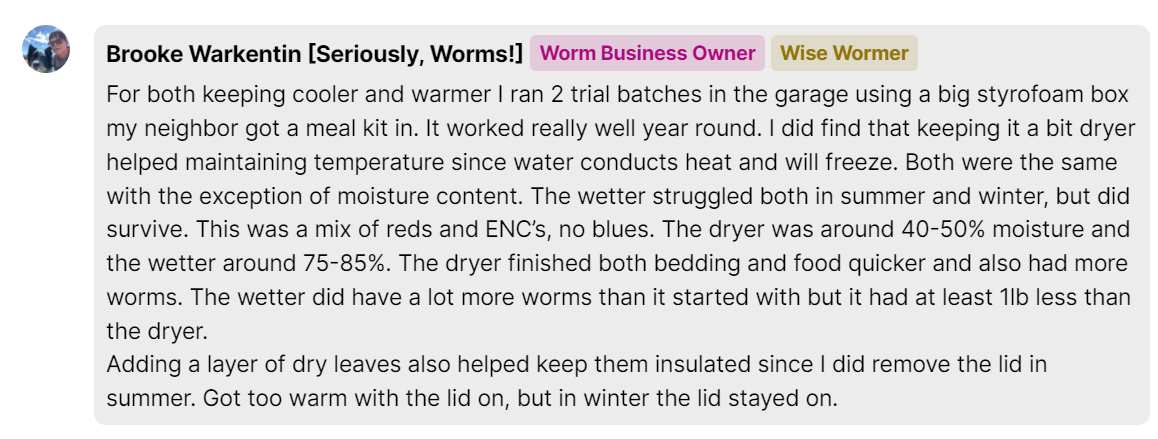
Brooke Warkentin ran an experiment where she kept one bin at 40-50% moisture and another at 75-80%. During the summer heat, she found the 50% moisture bin outperformed the higher moisture bin. This is interesting and goes against conventional thinking. Brooke is a wise wormer and knows her stuff. We suggest you try lowering your moisture levels to level the temperatures. Be careful that it doesn't get too dry. Measure your moisture levels with a meter like this one (Affiliate link). It will lose more moisture during the hotter months due to evaporation. She suggests covering the bin with a layer of dried leaves. Here is a screenshot of her advice.
 Click here to join the conversation and read the entire thread.
George G. shared an interesting YouTube video by NightHawkInLight. In the video, the YouTuber created a 65F PCM. This liquid can absorb heat at the perfect temperature for your bin. This is a great intermediary substance, as we already discussed above. Lay a bag of this liquid over your bin and place frozen water bottles on it. The bag's temperature would stay at 65F, protecting the worms from the uncomfortable cold of the ice bottles. The total heat removal from the PCM liquid is less than that from frozen water bottles, but the phase change is at the optimal temperature. The bottles remove the heat from the PCM as it removes the heat from your bin. Here is a screenshot from his comment.
 Click here to join the conversation
"There is always money in the banana stand..." -George Bluth
Joseph has a simple solution. Frozen bananas. Frozen food is the most common way to beat the heat. It kills the pest, breaks down the cell walls, and cools off your bin. Win, Win, Win. Remember, every time you feed, you increase the total heat generated. As the frozen food thaws and starts to decay, it produces heat. You need to reduce your nitrogen load during the hot summer months.

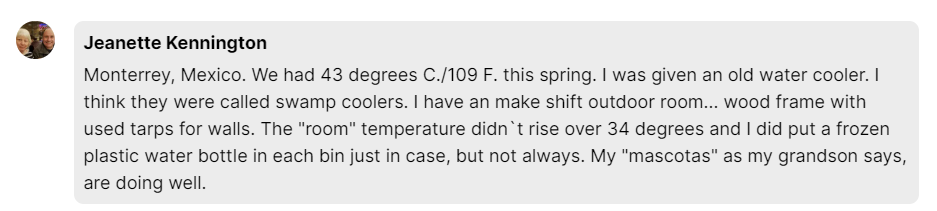
Jeanette knows a thing or two about heat. She created a small shelter in her bin to keep the heat down.
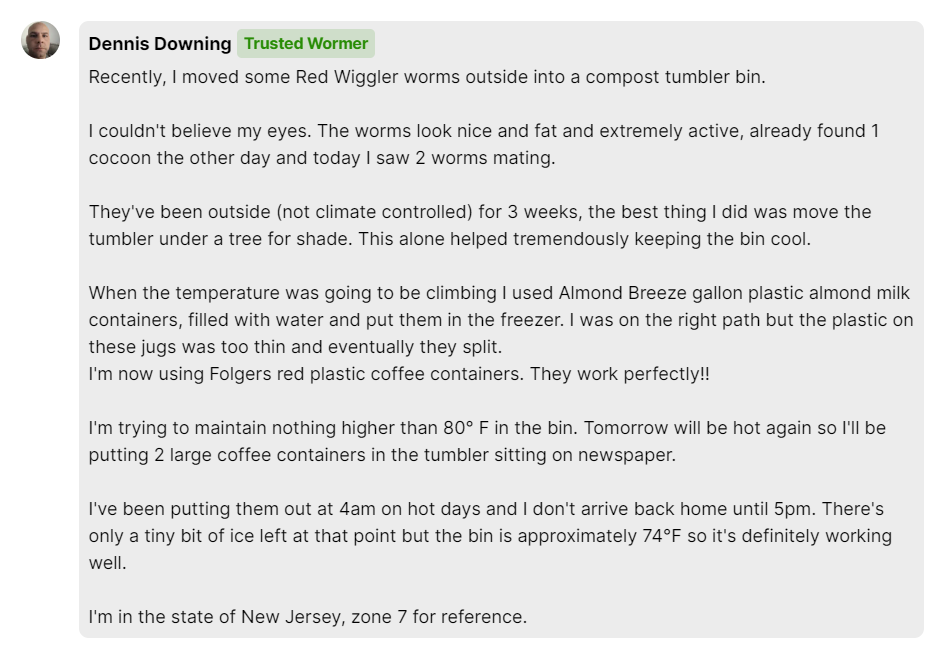
Dennis's experience is interesting. On the surface, you would think putting red wigglers in a tumbler would surely cook them. Dennis says otherwise, and don't call him Shirley. He put them in the shade and occasionally used a large, frozen, one-gallon plastic jug to reduce the temperatures.
Keith's approach is cool (pun intended) because the frozen food is pre-portioned in egg cartons. This is a simple, effective way to reduce the overall temperature in your bins.

Melodie's worms do not have to concern themselves with these struggles. She highlights the ultimate way to control the temperature: climate control.

Thanks again to the amazing Worm People Community for the lively discussion and tips.
Beat the heat
With record-breaking heat waves worldwide, we need to master the art of temperature control now more than ever. The best way to do this is by utilizing natural shade, limiting the total nitrogen you feed, controlling your moisture levels, and cooling the bin with frozen water bottles or frozen food. Use this guide to keep your bin cool during the summer.
Our Mission
We are Worm People. We do this for the love of worms but also the love of community. We love sharing knowledge and growing as a group. Our love for our little wriggly friends brings us all together. Through them, we nurture our living soil. Worm farming reduces waste in landfills and rejuvenates stressed depleted topsoil. You are creating a healthier, biodynamic world. You are making a difference!